 The Bay Window
Thrissur Pooram - A Cultural Bonanza
Of elephants, parasols, percussion, fireworks and a festival that brings a city together.
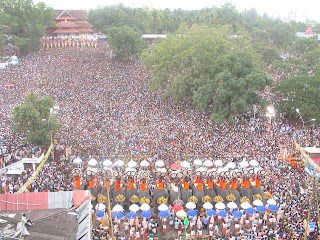
One of the most colourful temple festivals of Kerala, the spectacular Thrissur Pooram was introduced by the erstwhile Cochin Maharaja, Sakthan Thampuran (Rama Varma Kunjippilla, 1751–1805), and is celebrated in the Malayalam month of Medam (April–May).
Spanning about 36 hours, this spectacular festival of Kerala is often referred to as the ‘Pooram of Poorams’ and is witnessed by lakhs of enthusiasts, irrespective of religion or creed.
The word pooram in Malayalam literally means a group or a meeting. It is believed that during the Thrissur Pooram, the Gods and Goddesses of neighbouring provinces come together to pay their respects to Lord Vadakkunnathan.
History of the Thrissur Pooram
The Thrissur Pooram is said to have originated as a symbol of liberation from the oppressive caste system practised in ancient Kerala. The higher castes, represented by the Namboothiris, ruled over Kerala autocratically. The efforts of Prince Ravi Varma, better known as Sakthan Thampuran, brought an end to this repressive state of affairs.
It is believed that, once upon a time, the largest temple festival of Central Kerala took place at Aaraattupuzha, where smaller temples from in and around Thrissur eagerly participated in the festivities. But this practice was hindered by the aristocratic Namboothiri supremacy, which put an end to the custom and denied entry to these temples.
In such a situation, Prince Ravi Varma, who was then the ruler of Cochin State, invited these temples to Thrissur to pay their respects to Lord Vadakkunnathan, the presiding deity of the majestic Vadakkunnathan Temple.
The two other main temples of Thrissur, the Thiruvambadi Sri Krishna Temple and the Paramekkavu Bhagavathy Temple, were instructed to provide all help and support to the visiting temples.
Thus, Sakthan Thampuran succeeded in putting a stop to Namboothiri domination.
The Pooram has continued to be a tradition of Thrissur ever since, and even today it is conducted according to age-old customs and traditions. The much-loved episodes of the Pooram, namely Madathil Varavu, Elanjithara Melam, Thekkottirakkam and Kudamattom, are conducted with great vigour and vitality.
Religious Significance of the Thrissur Pooram
The Thrissur Pooram is considered, in every sense, to be a festival of the common people. People from all walks of life, irrespective of religion, caste or creed, gather to witness its spectacular festivities.
In this prominent temple festival held on the grounds surrounding the Vadakkunnathan Temple at Thrissur, known as Thekkinkadu Maidanam, two rival groups representing the Thiruvambadi Sri Krishna Temple and the Paramekkavu Bhagavathy Temple compete with each other in showcasing their capabilities.
The Thrissur Pooram commences with the Ezhunnellippu (procession) of Kanimangalam Shastha in the morning to the Vadakkunnathan Temple, followed by the Ezhunnellippu of six other minor temples.
In all, ten deities from in and around Thrissur pay their respects to Lord Vadakkunnathan during the Pooram.
Elephant Power
Think Thrissur Pooram, and the first image that comes to mind is that of magnificently caparisoned pachyderms, majestically lined up in all their glory!
Elephants are an unavoidable part of the Thrissur Pooram, and some of the best elephants from across the state are specially brought to grace the occasion. Both the Thiruvambadi and Paramekkavu factions compete heavily in this aspect and make full use of the rules that allow a display of a maximum of fifteen elephants each.
The sight of these impressive creatures, resplendent in their ornate decorations, making their way through the milling crowd and lining up on the temple grounds is indeed spectacular. It is witnessed not just by Malayalee enthusiasts but also by a large number of national and international tourists who reach Thrissur specifically for the occasion.
As part of the Pooram celebrations, the decorations to adorn the elephants (Aana Chamayam) are prepared well in advance each year by both the Thiruvambadi and Paramekkavu temple boards and displayed to the eager public prior to the Pooram. This is the Aana Chamayam Pradarshanam.
Kudamattom
The Kudamattom, or the display of decorated parasols atop the majestically lined-up elephants, is yet another colourful aspect of the world-famous Thrissur Pooram.
This particular event is highly competitive and is a matter of prestige for the Thiruvambadi and Paramekkavu temples, which fiercely compete with one another to put up the best display of parasols.
The Kudamattom brings deafening cheers and sighs of amazement from awestruck spectators, dazzled by the innovative and colourful display.
The most amazing aspect of this show is that every year, both temple factions bring in newer designs, each an epitome of creativity.
Various Pooram paraphernalia, along with the decorated parasols, are also put on display during the Aana Chamayam Pradarshanam held prior to the Thrissur Pooram.
Panchavadyam
The liveliness and spirit of the festivities during the Thrissur Pooram are enhanced manifold by the alluring effect of the Panchavadyam.
Maestros in their respective fields are brought in by the two competing temple factions, and the result is pure magic!
The sight of multitudes of people waving their arms and swaying their heads to the beat of the music is indeed fantastic.
No other festival in Kerala draws such an unbelievable crowd to a single event.
The Display of Fireworks
The Thrissur Pooram Vedikettu, or display of fireworks, is undoubtedly one of the most eagerly awaited attractions of this unique temple festival.
Both the Thiruvambadi and Paramekkavu temples are known for putting up spectacular firework displays.
Thousands of people throng the venue and nearby areas just to witness the innovative and breathtaking display, which begins sometime after midnight and lasts for several hours.
A couple of days prior to the Thrissur Pooram, a Sample Vedikkettu, or sample display of fireworks, is held, and it is equally enthralling.
Thrissur Pooram – A Cultural Bonanza
The Thrissur Pooram is considered to be one of the most popular temple festivals of Kerala. Religious unity is one of the highlights of this world-famous event. Even though it is a Hindu temple festival, both the Muslim and Christian communities play a prominent role in its celebrations.
Most of the pandals put up for the Pooram are the result of the indigenous craftsmanship of experts from the Muslim community, who work untiringly for months ahead of the festival.
During the two days of the festival, CMS High School, located on the western side of Swaraj Round and owned by the North Kerala Diocese of the Church of South India, becomes a hub of activity, serving as the headquarters of the Thiruvambadi Devaswom.
The temple elephants are tethered in the school compound, and the Aana Chamayam Pradarshanam prior to the Pooram is also held at the school.
The decorated parasols for the Kudamattom are said to be offerings from various churches.
At a time when the secular fabric of Indian society seems to be under strain and feelings of religious intolerance appear to be on the rise, one cannot but admire the relevance of the Thrissur Pooram—a festival that, in its own unique way, brings people of different religious communities together under one banner.
First published on my first blog, God’s Own Country!!!, 20 April 2013.